Case Study
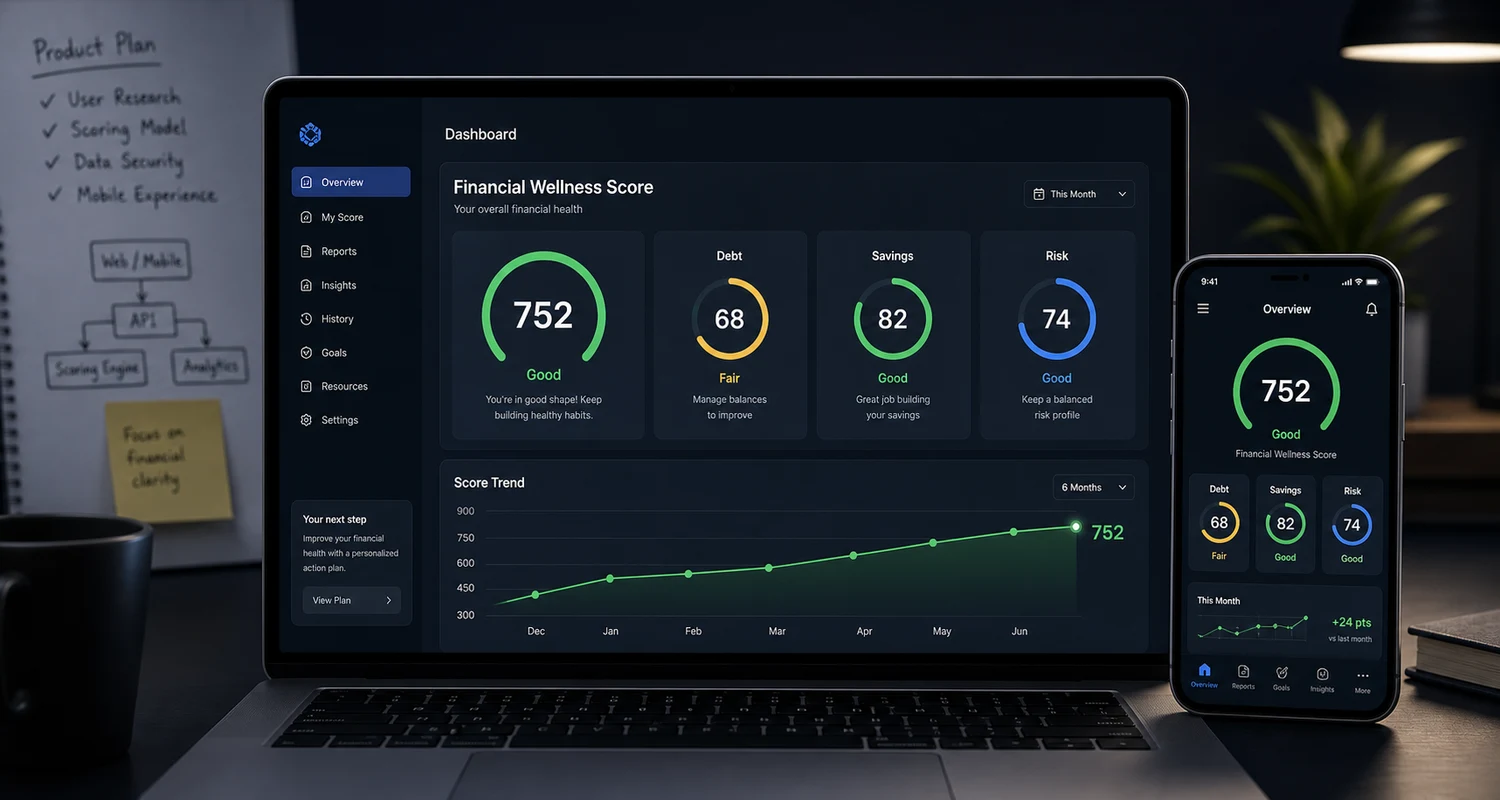
PFScores Financial Wellness Platform
50%
API latency reduction
8
financial scoring domains
Web + mobile
multi-platform delivery
Product experience
A guided financial wellness journey across web and mobile
PFScores needed to make complex financial inputs feel approachable. The product experience guides users through account setup, score-domain questions, financial standing views, reports, and follow-up insights without exposing the complexity of the scoring model underneath.
01
User onboarding
Authentication, profile setup, and protected routes create a secure entry point for personal financial data.
02
Score-domain forms
Users move through structured inputs for net worth, cash management, retirement, education, purchases, dependent protection, and overall financial health.
03
Reports and history
The app turns submitted data into scores, score history, graphs, PDF reports, and what-if planning context.
Product workflow

Step 1
Step 2
Step 3
About the product
A financial wellness product beyond a single credit score
PFScores is a financial scoring SaaS product designed to help users understand broader financial wellness signals across debt, savings, risk, retirement, education, major purchases, dependent protection, and financial health. The product needed to serve both everyday users and a scalable fintech operating model.
Business context
Financial guidance needs clear UX and reliable domain logic
Financial scoring products have to balance two very different problems: a simple user experience for people entering sensitive financial information, and a rigorous backend model that can calculate, store, explain, and revisit financial wellness signals over time.
The challenge
Turn complex financial inputs into a coherent product system
The platform needed consistent web and mobile experiences, protected account flows, domain-specific forms, score history, reporting, benchmarking, and backend APIs that could support future white-label and deployment needs.
- Design a multi-step scoring experience that users could complete without feeling overwhelmed.
- Model financial domains cleanly across React, Expo, GraphQL, Prisma, and PostgreSQL.
- Support reports, PDFs, score history, and graph views from the same underlying data.
- Keep authentication, protected routes, and mobile storage aligned across platforms.
- Prepare the architecture for AWS-oriented deployment and future product expansion.
What QtaSO delivered
Full-stack product engineering for a fintech scoring platform
QtaSO helped engineer the frontend, backend, mobile, and deployment foundation behind PFScores. The work connected React/Vite web screens, Expo mobile flows, GraphQL APIs, Prisma/PostgreSQL persistence, score-domain logic, PDF/report generation, and AWS-ready deployment patterns.
- React/Vite web application architecture.
- Expo and React Native mobile app workflows.
- GraphQL API and Prisma/PostgreSQL data model integration.
- Domain scoring flows for household financial inputs.
- PDF/report generation and score-history experiences.
- AWS-oriented deployment and white-label configuration support.
Impact
A scalable fintech foundation with faster APIs
The platform created a reusable foundation for financial wellness scoring across web and mobile while supporting score history, reporting, benchmarking, protected account flows, and future fintech expansion. Backend optimization work reduced API latency by 50%, improving the responsiveness of a workflow that depends on many score-domain interactions.
Architecture
AI Video Generation Pipeline
01
Account setup
02
Financial inputs
03
GraphQL API
04
Prisma scoring data
05
PFI score engine
06
Reports and PDFs
07
Web and mobile delivery
Platform output
Scores, reports, and financial wellness views
The final product turns sensitive financial inputs into actionable score views, education, score history, reports, and planning context across web and mobile.
Render-ready formats for listing pages, social feeds, ads, and sales follow-up


Next step
Ready to automate video production?
Turn property data, media assets, and campaign rules into a repeatable AI-powered workflow.